EVE Audio for Young Producers: Hearing-Safe Monitors
By Avery Cole • 15th Feb
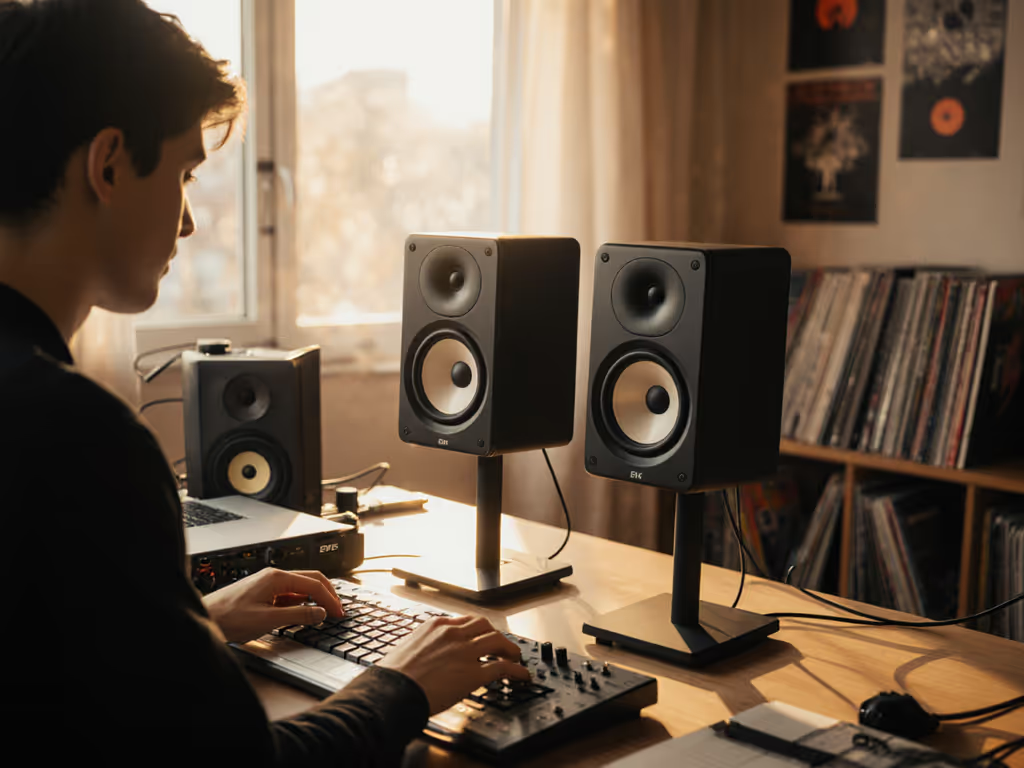
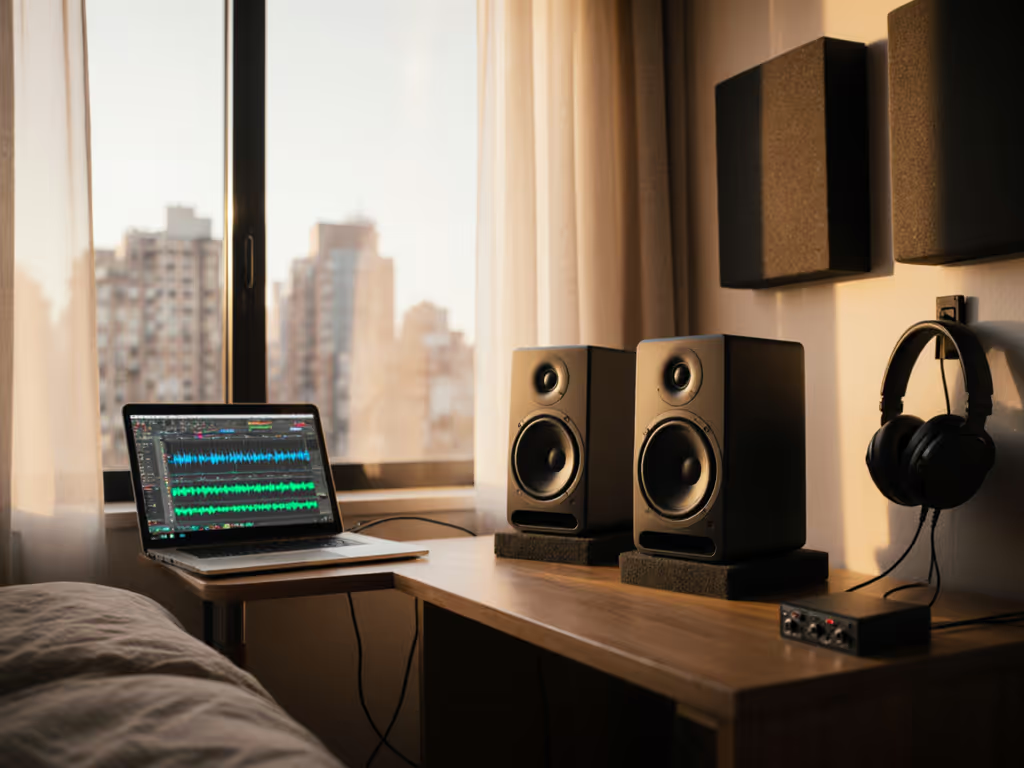
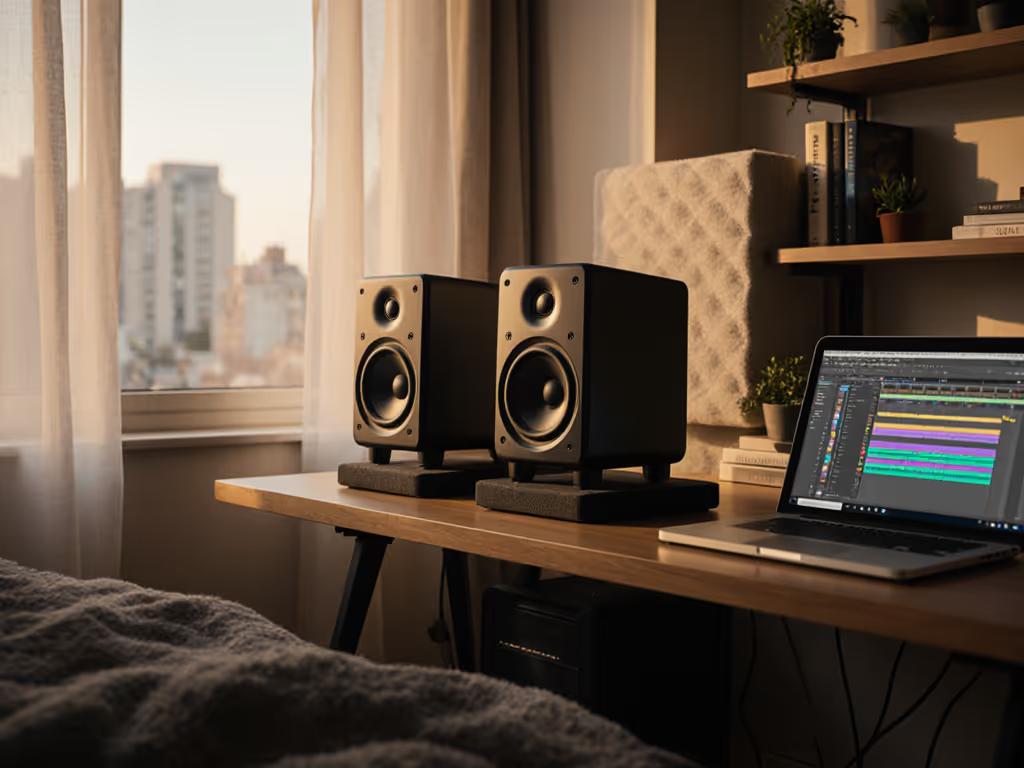
EVE Audio studio monitors are purpose-built for producers working in compact rooms at low volumes (the exact scenario where most nearfield monitoring fails). Young producers and small-room mix engineers face a hard truth: monitors that sound impressive at 85 dB SPL often lose low-end clarity, imaging stability, and tonal honesty at the 70-75 dB range where neighbors, roommates, and fatigue constraints force them to work. Accessible studio equipment that maintains translation across quiet and loud playback levels is not a luxury feature. It is the difference between mixes that travel and revisions that pile up.
This article breaks down how EVE Audio's nearfield designs address the specific monitoring needs of emerging producers: predictable low-end behavior in small rooms, low-SPL clarity, DSP tools that reduce room modes without adding latency, and honest maximum SPL ratings that respect both your ears and your neighbors.
The Small-Room Low-SPL Problem
Most studio monitors are voiced and tested in treated rooms at 83-90 dB SPL. Drop the needle to 70-75 dB in a bedroom or apartment, and several things break:
- Bass nulls and peaks become tyrannical. Room modes at 60-120 Hz don't shrink with SPL; they still color every kick and sub-bass decision.
- Tweeter directivity collapses. Off-axis response becomes harsh or dull. A 0.3 m shift on your desk changes the balance by 2-3 dB.
- Distortion rises relative to signal. At low SPL, driver excursion requirements don't scale linearly. Some monitors mask this by boosting the midrange or treble (which teaches you to mix thin). For foundational tips on fixing these problems at the source, see our room treatment essentials.
After testing my own mixes on earbuds, old Bluetooth speakers, and a hatchback at 72 dB, I realized the monitor that didn't lie at quiet levels was the one that also held up in a car or on streaming. Translation first: if it translates at 72 dB, it translates everywhere.
EVE Audio monitors use several techniques to hold low-SPL accuracy: A DSP-based design with 24-bit/192 kHz Burr-Brown A/D converters allows precise filtering and room adaptation without adding coloration or latency. The Air Motion Transformer (AMT) tweeter (hand-folded diaphragms that move air 4x more efficiently than dome tweeters) delivers high-frequency detail and minimal distortion across a wide listening angle, crucial when your desk forces off-axis listening. Bass-reflex or passive-radiator designs keep low-frequency response predictable in small, boundary-coupled spaces.
Comparing EVE Audio's Nearfield Range
EVE Audio's lineup splits into two practical lanes for young producers:
Compact, Ultra-Budget: SC204
The SC204 is a true desktop speaker: 4-inch woofer, 50 W per channel, maximum SPL of 96 dB. Frequency range is 64 Hz to 21 kHz. It's tight. You will not feel sub-bass through your ribs at 72 dB (and that's honest, not a flaw). If your bedroom or apartment can't shake without waking roommates, this monitor tells you the truth about what's down there. At compact dimensions (5.7" x 9.1" x 7.7") and 8.4 lbs, it fits on any desk or shelf. Trade-off: bottom-end extension stops at 64 Hz. EDM and hip-hop producers working with 808s should add a sub; dialogue and acoustic music stay clean.
Mid-Range Workhorse: SC205
The SC205 balances bottom-end reach and compact footprint: 5-inch woofer, 100 W total output, maximum SPL of 101 dB, frequency response of 53 Hz to 21 kHz. The additional bass extension (53 Hz vs. 64 Hz) gives you 808s, kick fundamentals, and room-mode resolution without requiring a subwoofer immediately. At 101 dB max SPL, headroom is genuine; you can push to 80-85 dB for occasional loud reference checks without the monitor winding down or clipping. Dimensions are 6.89" x 10.83" x 9.17", still small enough for tight desk setups.
For most young producers in untreated apartments, the SC205 is the practical sweet spot: enough low-end reach to catch your mixes whole, enough SPL headroom to verify translation at moderate levels, and compact enough to fit the room.
Full-Range Precision: SC207
The SC207 is EVE Audio's reference 2-way nearfield, stepping up to a larger woofer and the proprietary AMT RS2 tweeter, which uses an even larger magnet system for higher output and lower distortion. Frequency response extends lower, SPL headroom is higher, and imaging stability improves. If budget allows and your desk can accommodate a slightly larger monitor, the SC207 is the monitoring upgrade that justifies itself every session.
DSP, Room Adaptation, and Off-Axis Response
One reason EVE Audio monitors translate consistently at low SPL is their DSP architecture. Every monitor includes:
- SMART-knob control: Adjustable filters, volume, and room-response compensation directly from the front panel.
- Parametric EQ and bass/treble boost/cut options: Target room modes (usually 50-120 Hz) without affecting midrange clarity.
- Phase and latency-free processing: DSP filtering adds no audible delay, so your input-to-speaker timing stays tight for monitoring live performances or podcasting.
- Protective limiting: Prevents tweeter and woofer overload across the entire frequency range.
The AMT tweeter design also ensures wide, stable off-axis response. For measurement-backed context, see our off-axis response comparison. At 72 dB SPL sitting 0.8 m from the monitor at a 15 degrees off-center angle, the SC205 or SC207 maintains tonal balance; a 0.3 m desk shift doesn't flip the mix bright or dark. This is the opposite of tweeter-heavy monitors, which sound impressive on-axis but harsh in the real world.
Hearing Safety and Sustainable Workflow
Young producers often confuse loudness with clarity. Working at 85-90 dB SPL for 4 hours wears down your ears; by evening, you make bad EQ moves. Protect your ears and your mixes with our safe studio monitor level guide. At 70-75 dB, you hear actual low-level detail and stay accurate for longer sessions.
EVE Audio monitors implement several safety features:
- Safe Fade-In: Volume ramps up gradually when powered on, protecting against accidental speaker-level mishaps.
- Standby mode with power draw drop to 1 W: Leave monitors on standby instead of unplugging; they consume less power than a LED bulb.
- Honest maximum SPL ratings: The SC205's 101 dB ceiling is real headroom, not marketing fiction. You know your limit.
Monitoring at 72-75 dB SPL with a 6-8 dB peak margin for occasional loud reference checks is sustainable. Your ears stay sharp; your mixes stay trustworthy. Educational hearing-friendly monitoring is not a constraint; it is a skill that protects your career.
Practical Integration for Tight Rooms
Beginner studio setups for hearing challenges require thoughtful placement. EVE Audio's compact nearfield monitors fit three key placements:
- Desk stands at ear level, angled slightly down and 0.7-1.0 m away: minimizes direct floor/wall reflections; imaging stays stable across the sweet spot.
- Shelf mounting with decoupling pads: Reduces desk coupling and low-frequency boom; threaded inserts on SC205 and other models enable quick racking.
- Subwoofer blending: If adding a compact sub for extended low-end, EVE Audio's DSP presets allow you to set crossover frequency and phase alignment, preserving translation while cutting room-mode energy.
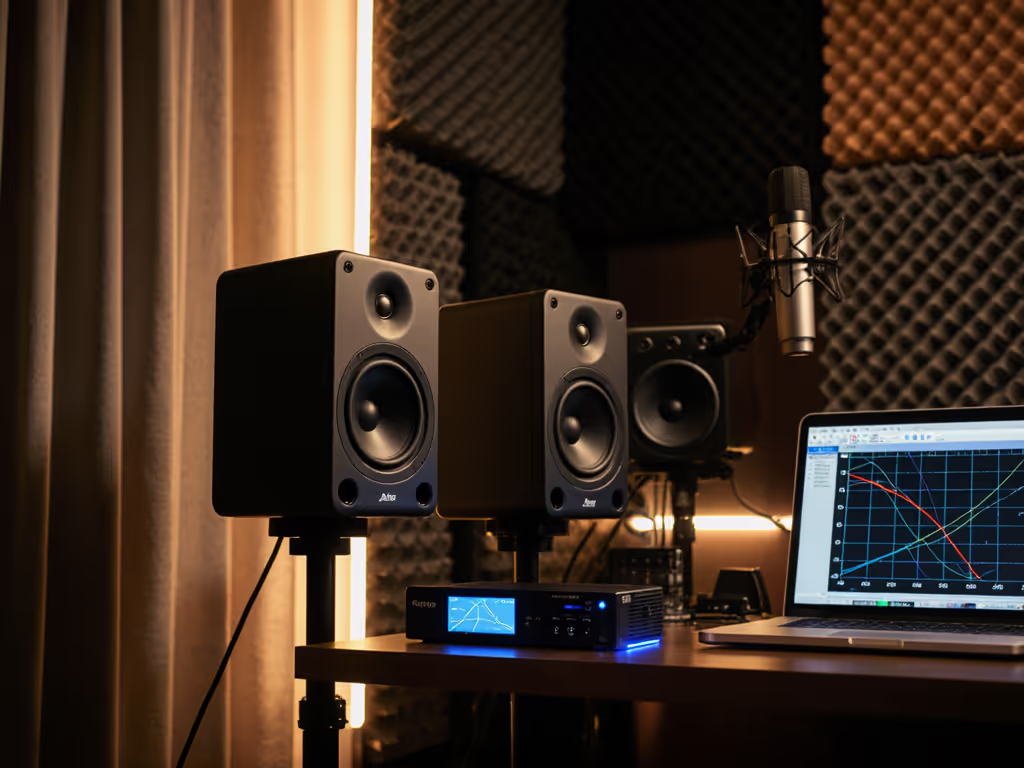
Starting at 72 dB, dial in room modes using a tone generator and measure with a simple SPL app. Then engage EVE's parametric filters to notch problem frequencies (typically 60, 100, or 125 Hz). Test by A/B-ing your most accurate mix: if details snap into focus and bass stops rumbling, the filter worked. Lock the setting and trust it.
Comparing Translation Across Playback Devices
| Device | Target Goal | What EVE's Low-SPL Clarity Buys You |
|---|---|---|
| Earbuds (Apple, AirPods) | Mid-forward, slightly hot treble | Hear if your mids are buried; catch over-compression |
| Bluetooth speaker | 300 Hz-3 kHz bump, rolled highs | EVE's flat response catches color before translation |
| Car (typical sedan) | Bass up +6 dB, narrow stereo image | If SC205/207 is honest at 72 dB, kick/bass won't over-correct |
| Streaming (Spotify, Apple Music) | Normalized loudness, slight bass/treble dip | Low-SPL mixes reveal the actual balance; no surprises |
| Monitoring speaker (reference) | Flat, wide stereo, fast transients | EVE's DSP and AMT tweeter preserve timing and imaging |
Young producers who check mixes on multiple devices catch revision cycles early. EVE monitors reduce false positives, those moments when you EQ your mixes to match one playback system and then they sound wrong everywhere else.
Inclusive Audio Education and Budget Reality
The SC204 and SC205 sit in the $300-550 USD range (prices vary by region and retailer). This is affordable accessible monitors pricing: not so cheap that they cut corners on the DSP or AMT driver, and not so expensive that bedroom producers must save for months. A single studio session where a better monitor catches a sloppy bass move or harsh vocal layer pays for itself in client feedback and revision cycles avoided.
Conclusion: Translation First
EVE Audio monitors are not the flashiest. They don't boom at you in a demo. They won't make a mediocre mix sound thrilling in the room. What they do is tell the truth at 72 dB SPL in a 10x12 ft bedroom with reflective walls and no acoustic treatment. They maintain that truth at low listening angles. They protect your hearing while expanding your usable working range. They work with DSP to adapt your space without latency or coloration.
For young producers and small-room mix engineers, the metric that matters is not how a monitor sounds in a treated studio; it is how your decisions travel. EVE Audio's design philosophy (precise room adaptation, low-SPL clarity, honest limiting, and wide off-axis response) reflects that priority. Start with the SC205 if your budget allows; it gives you 53 Hz bottom-end reach and 101 dB headroom. If desk space or budget forces the SC204, you get truthful compact monitoring and a clear upgrade path to a subwoofer later.
Place them at ear level, 0.8 m away, angled at 15 degrees. Set volume to 72 dB using pink noise. Engage one room-mode filter if needed. Mix for 3 hours, then walk the track onto your phone and car. If it holds, if the kick feels solid, the vocals sit, the stereo image doesn't collapse, you have found the monitor that fits your room and your workflow. Translation first. Everything else follows.
Related Articles