Multi-Genre Studio Monitors: Translation Tested
By Avery Cole • 23rd Feb
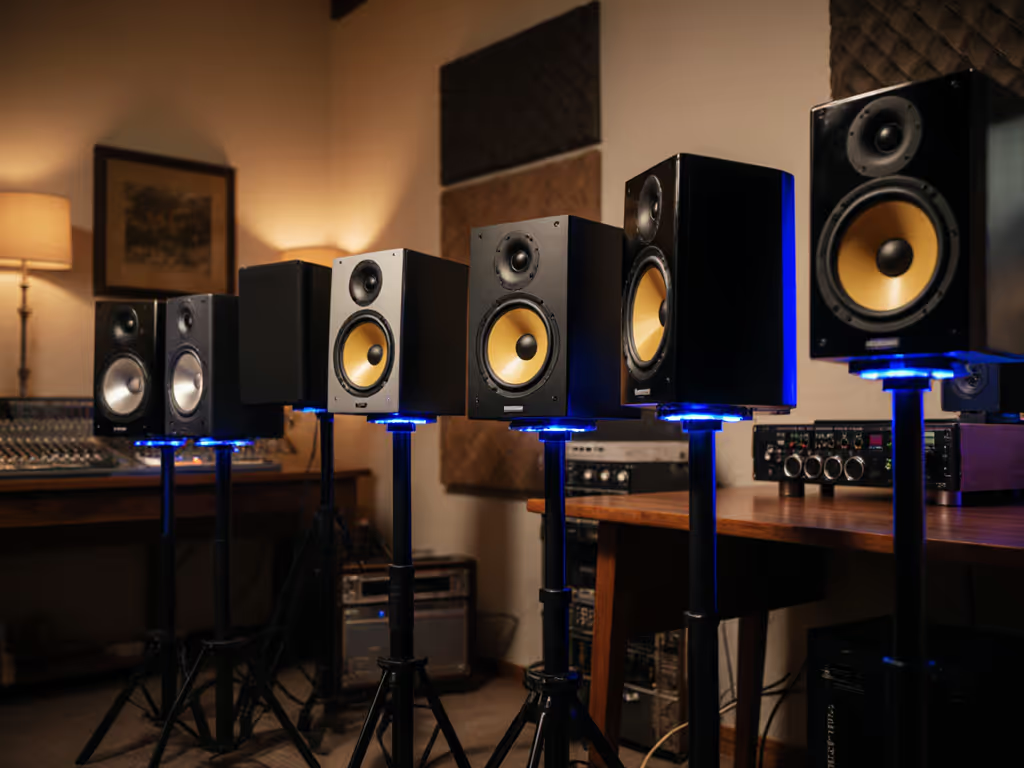
Finding good studio monitors that work across hip-hop, pop, EDM, indie, and spoken word in a 10×12 bedroom is the wrong problem to solve. The real question: which monitors tell you the truth at 72 dB, night after night, without needing to rebuild your mix in the car?
Versatile monitoring solutions don't mean "flat response everywhere." They mean predictable translation: kick decisions, vocal balance, and stereo width that hold up on earbuds, Bluetooth speakers, club systems, and streaming platforms with minimal guesswork. That's what this guide tests.
Why Multi-Genre Monitoring Fails in Small Rooms
Most nearfield monitors sound good in the sweet spot. They sound nothing like themselves three feet away, on your left ear, or at low volume. Add a compact room (8×14 feet of drywall, desk, and windows), and the 60-120 Hz zone becomes a crapshoot. Kick clarity vanishes. Bass either vanishes or bloats. Stereo imaging collapses when you move six inches left.
Then there's SPL. A monitor rated "flat to 40 Hz" is often rated at 85 dB. At 72 dB (sustainable, quiet, neighbor-friendly), the same speaker often loses low-end articulation, and the tweeter suddenly sounds thin. Your mix sounds right at work but feels dark at home. That's not the monitor's fault. It's a mismatch between how you mix and how the room listens.
Genre diversity makes this worse. EDM 808s demand tight, articulate bass below 80 Hz. Indie vocal mixes need a stable midrange at low SPL so you hear compression artifacts. Podcasts require cross-genre monitoring accuracy: neutral enough for classical drums, warm enough that voice artifacts don't stack.
What Translation Actually Means
Translation isn't a speaker trait. It's a process.
Early in my mixing career, I chased monitors that sounded big (Focal, PMC, the usual suspects). My mixes sounded extraordinary in the room. In the car, they crushed. After too many recalls, I built a portable test loop: pink noise alignment at 72 dB, five reference tracks (one EDM, one vocal pop, one acoustic, one metal, one podcast), and three real-world checkpoints (a Bluetooth speaker, old earbuds, and a hatchback stereo).
I tested everything at that one playback level. Not loud checks. Not excitation. Just: Does this monitor lie less at 72 dB?
The monitor that fooled me least became my standard. Not the one that felt impressive. The one I could trust.
This is what separates flexible studio reference monitors from expensive room warmers. Flexible means honest at low SPL. Flexible means off-axis response doesn't collapse. Flexible means you can place it on a desk without bass bloom eating your kick.
FAQ: Genre-Adaptive Monitoring in Compact Spaces
How Do I Know If a Monitor Works Across Genres?
Three numbers matter: nearfield frequency response (50 Hz-20 kHz ±3 dB is honest; ±5 dB hides problems), off-axis response (−3 dB at 90° tells you how fragile the sweet spot is), and low-SPL linearity (does it still flatten out at 70 dB, or does the tweeter get shrill).
Manufacturer specs rarely volunteer the third. You verify it: test pink noise at 72 dB, set one monitor to that level, move your chair, and listen for tonal shift. If the highs stay neutral when you move, the monitor has controlled directivity. If they jump up or down, the monitor is masking placement problems.
The Kali Audio LP-6 V2, for instance, uses a waveguide designed to keep the tweeter level tight across a wide listening area.[1] That's not hype. It's audible. At 72 dB, the highs don't vanish when you shift slightly. For EDM and pop, where stereo width matters and your head moves during mixing, that's a usable control.
Will a Single Monitor Handle EDM, Vocals, and Podcast Mix Chains?
No monitor is born neutral. But a universal reference monitor with a tunable rear panel and moderate tweeter tuning (not bright, not dark) can handle all three if you've matched gain and treated the room's primary modes.
The KRK Rokit 5 Gen 5, redesigned in recent years, softened its trademark bass bump.[1] Gen 5 is tighter, flatter, and less prone to the classic KRK color. Still not a Yamaha HS8 (which targets absolute neutrality), but close enough. With the Gen 5's DSP room-EQ options, you can dial in a front-port setup on a desk.
For vocals and pop, that flatness matters. For EDM, you'll hear every 80 Hz rumble without the old KRK mud masking sloppy sub work. For podcast, the midrange detail is solid.
Yamaha HS8 is the standard reference. If your mix sounds good on these, it sounds good almost anywhere.[1] No tricks, no waveguides, no marketing. Just flat.
What About Low-Volume Accuracy? Can I Mix at 72 dB All Night?
Yes, if you choose the right monitors and validate that choice.
Low-SPL mixing is not a workaround; it's proven ergonomic. Learn how to set safe monitoring levels without sacrificing translation. Your ear's Fletcher-Munson curve means you hear proportionally less bass and treble at 72 dB than at 85 dB. Many engineers compensate by boosting low end, not realizing the monitor is the culprit, not the mix.
Choose a monitor with a wide amplitude response at low SPL. The Neumann KH 120 II, a DSP-driven compact, is engineered for this: flat at 70-80 dB, with onboard calibration that accounts for room modes in a small space.[1] It's pricey, but if you're mixing 6 hours a night and can't treat the room, this is where low-SPL reliability lives.
The Adam Audio A7V ribbon tweeter, praised for detail and high-frequency clarity, also holds linearity at modest levels.[1] Ribbon tweeters tend to have smoother off-axis response than domes, which means less harshness when you lean in close, a small-room bonus.
Validate at your level: pink noise at 72 dB, check it on a reference SPL meter, move your chair, and ask: Does the balance change? If not, the monitor passes the low-SPL test.
I Have Desk Reflections and No Room Treatment. How Do I Reduce Boundary Coupling?
Genre-adaptive monitoring requires isolation and a placement strategy.
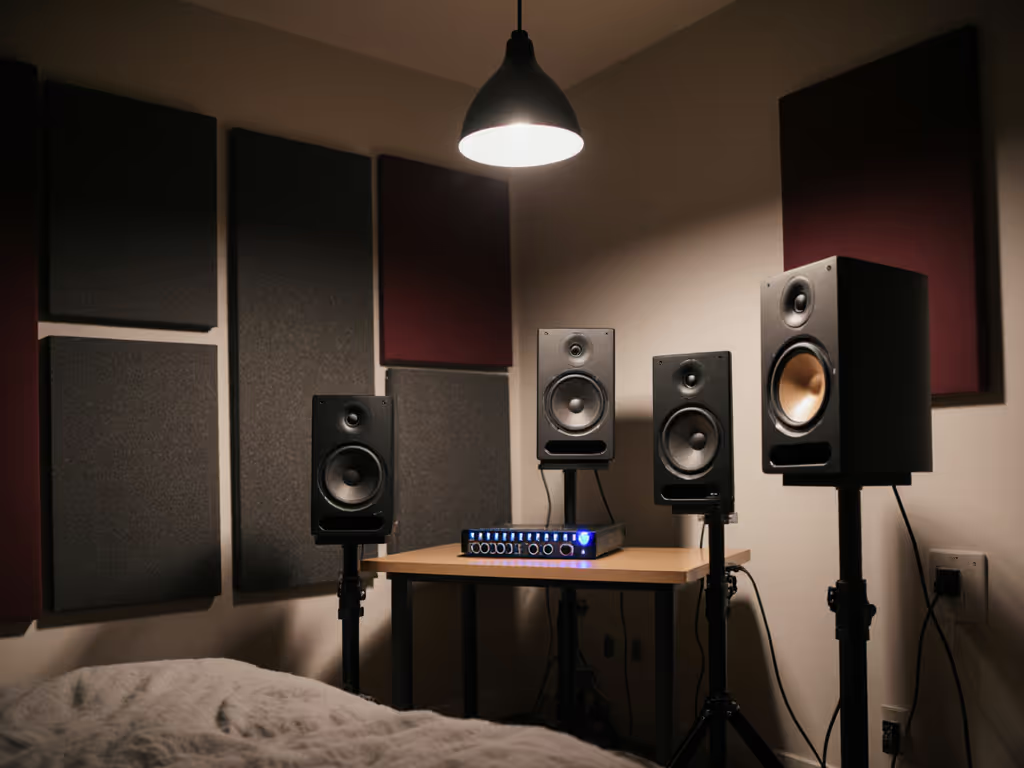
First: speaker isolation. Isolation pads decouple the monitor from desk vibration. Not magic, but measurable, typically a 6-10 dB reduction in the 100-300 Hz zone where desk/cabinet resonances live. Pair this with toe-in: aim each monitor at ear level, not the back wall. This reduces early reflections off the desk surface.
Second: desk distance. If your nearfield is 0.8 m from ear to tweeter, bass reinforcement at the desk is delayed. For placement specifics and monitor height to reduce reflections, see our monitor height and placement guide. Move the monitors forward, away from the back edge of the desk. Angle them slightly inward so the acoustic center (tweeter + woofer blend) points at ear level.
Third: rear-port vs. front-port. A rear-ported monitor fires bass toward the wall, reinforcing room modes at 60-80 Hz (SBIR (speaker boundary interference region)). Front-ported monitors fire toward your ears. On a desk, front-port wins. Check the spec sheet; the Kali LP-6 V2 is front-ported, the Yamaha HS8 is rear-ported. For a desk setup, the Kali's port placement is more forgiving.
How Do I Test Translation Without Leaving the Room?
You need a repeatable checklist, not new monitors every month.
Step 1: Pink noise at 72 dB, measured on an SPL meter at ear level. For a step-by-step process, follow our home studio monitor calibration guide. Adjust trim to match.
Step 2: Five reference tracks:
- EDM (kick, sub, stereo synth clarity)
- Pop vocal (balance, compression artifacts, sibilance)
- Acoustic (imaging, room reverb, string detail)
- Metal or rock (transient snap, vocal edge, guitar tone)
- Podcast or dialogue (intelligibility, EQ artifacts, low-mid warmth)
Step 3: Blind A/B on three playback systems:
- Laptop speakers
- Cheap Bluetooth speaker
- Car stereo (hatchback or sedan)
Step 4: Mark what breaks. Kick disappears on laptop? The monitor's low-end extension is suspect. Sibilance jumps on Bluetooth? The tweeter is uneven. Bass vanishes in the car? Desk boundary coupling is exaggerating your sub decisions.
Step 5: Trust quiet decisions. If it translates at 72 dB, it translates everywhere. If it requires car checks to feel right, the monitor is the problem, not the room.
Should I Add a Subwoofer for Multi-Genre Work?
Only if the monitor cannot resolve below 60 Hz without exaggeration. If you do add low end, start with tested studio subwoofer bundles that integrate cleanly in small rooms.
The Kali LP-6 V2, with its 6.5-inch woofer, extends honest bass to around 50 Hz in a small room.[1] That's kick territory for most genres. A sub is nice for EDM and hip-hop 30-50 Hz work, but it introduces phase and crossover complexity. In a 10×12 room, a single sub compounds modes instead of smoothing them.
Start without. Test your low end at 72 dB on your reference tracks. If the kick and 808 feel present and detailed, the monitor is enough. If kick clarity vanishes, bass blooms unpredictably, or you're constantly unsure of sub balance, then add a sub. Match it to the monitor's impedance curve, cross over at 80 Hz, and phase-align at ear level.
Which Monitors Handle Genre Switching Without Recalibration?
Monitors with onboard DSP and preset tuning let you dial in for room, not genre. The Focal Trio6, a 3-way monitor, can switch between 1-way, 2-way, and 3-way modes (almost like having three monitors without rewiring).[2] That's useful for A/B'ing, but not for genre switching; the room doesn't change, so the mode shouldn't either.
Instead, choose a monitor with stable midrange and controllable low-end without DSP tricks. Yamaha HS8, Adam A7V, and the Neumann KH 120 II all do this. They sit flat and let your mix breathe across EDM, pop, and spoken word without flavor. Your EQ moves stay clean. Your compression decisions hold up.
Summary and Final Verdict
Multi-genre mixing in a small room demands universal reference monitors: tools that don't color the sound, don't lie at low SPL, and don't require perfect placement to sound honest.
Start with a 5-7 inch monitor rated for nearfield, with front porting and a waveguide or ribbon tweeter that maintains linearity off-axis. Test it at 72 dB against five reference tracks on three playback systems. If the kick, vocal, and stereo width remain stable and believable across those systems, the monitor has passed translation.
The Kali Audio LP-6 V2 wins on value and waveguide control.[1] The KRK Rokit 5 Gen 5 is solid if you need a slightly fuller low end and DSP flexibility.[1] The Yamaha HS8 is the gold standard for absolute flatness and reliability across genres.[1] The Neumann KH 120 II is the pro choice if low-SPL accuracy and DSP room correction are non-negotiable.[1] The Adam Audio A7V splits the difference: detail and controlled off-axis response without excessive cost.[1]
Isolate with pads, angle with toe-in, place forward on the desk, and validate at 72 dB. Trust quiet decisions. If it translates at sustainable volume, your mixes will translate everywhere, and your clients will approve faster. That's not a monitor feature. That's professionalism.
Related Articles