Phase-Coherent Monitoring: Fix Your Mix Translation
By Lila Okafor • 10th Jan
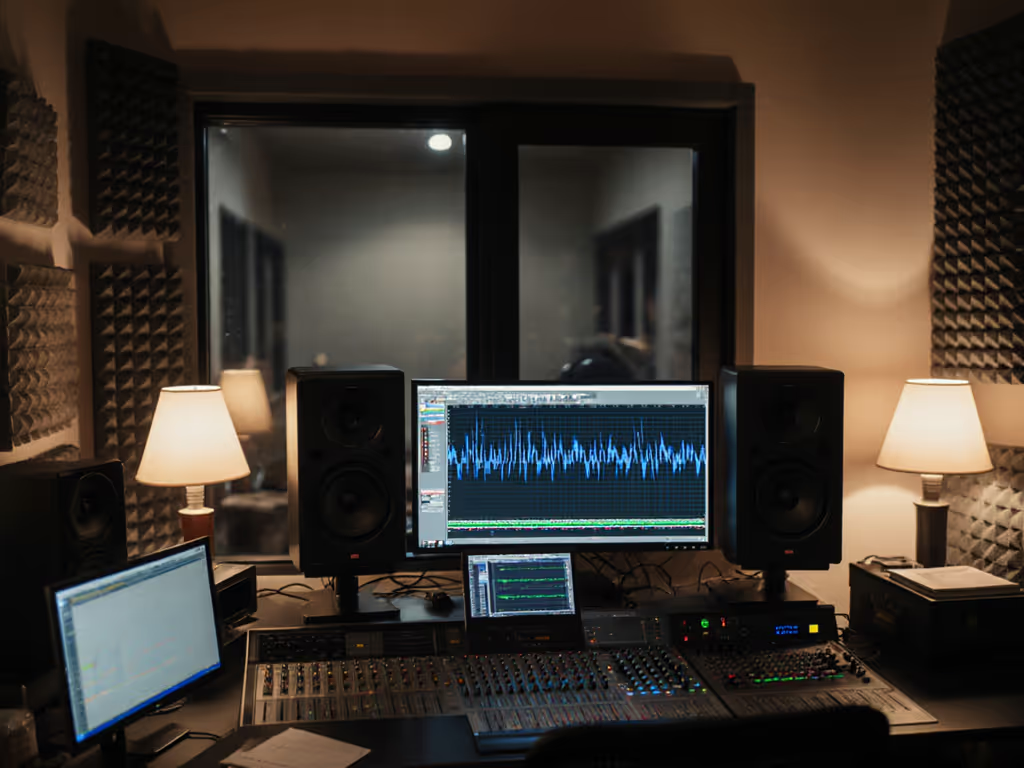
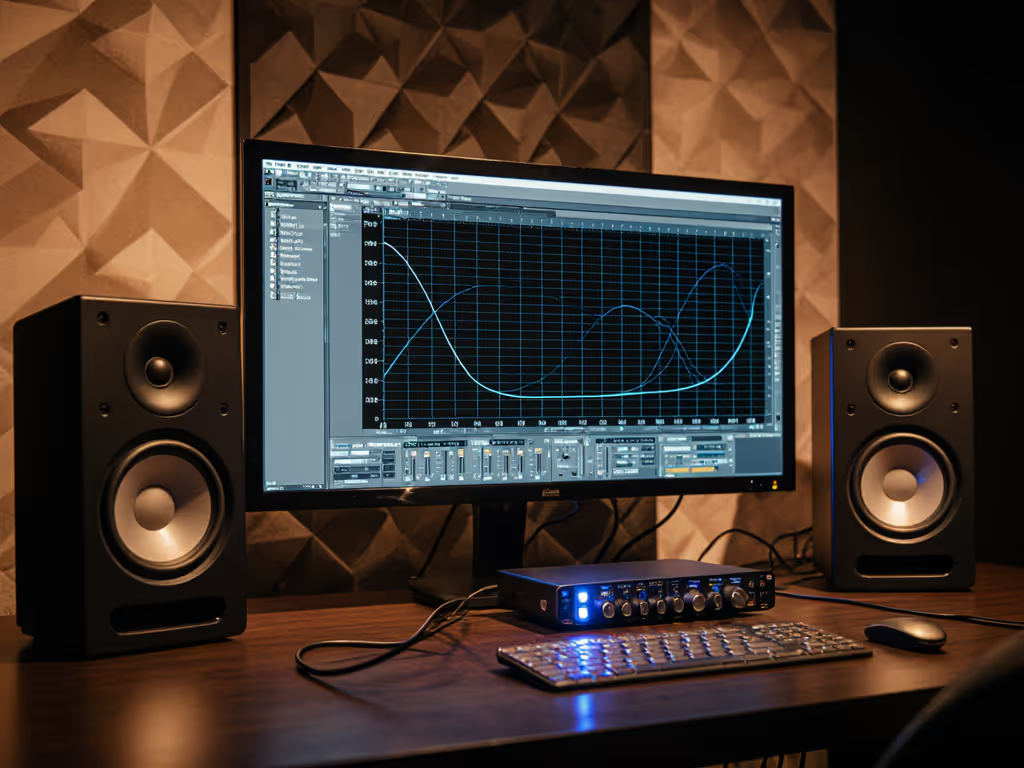
For independent producers wrestling with translation failures, especially bass inconsistencies and smeared transients, studio monitor phase coherence and phase alignment monitoring are non-negotiable starting points. But in compact rooms (8x10 ft to 12x14 ft), phase truth isn't found in spec sheets alone. It's revealed only when you align speaker behavior with your room's acoustic reality. Controlled directivity and smooth power response make small rooms more predictable, a lesson I learned after watching a client's "sparkly" top-end collapse when we overlaid their room's 200 Hz desk resonance. Curves matter, but only as far as rooms allow.
Why Phase Coherence Matters More Than Specs Suggest
Isn't phase coherence just marketing hype for high-end studios?
No, but it's often misapplied in small rooms. True phase coherence means drivers (woofer/tweeter) reproduce transients without time-smearing. At 1 m listening distance in compact spaces, this ensures:
- Transient coherence within 0.1 ms of ideal (audible as tight kick drums, not "smeared" attacks)
- Minimal comb filtering below 500 Hz where room modes dominate
- Accurate stereo imaging even with minor head movements
However, no speaker maintains perfect phase coherence across all angles. In untreated rooms, off-axis measurements are more critical than on-axis specs. If a monitor's 30° horizontal dispersion deviates by >15 dB above 2 kHz, phase alignment becomes irrelevant, your desk reflections will ruin imaging before driver timing errors ever register. This is why I ignore "minimum phase" claims without spatial averaging data.
My mixes sound thin on earbuds when monitors sound full. Is phase the culprit?
Often, yes, but not how you think. Phase issues in mixing typically manifest as:
- 60-120 Hz bass dropout on mono devices (phones, earbuds) due to out-of-phase low-end summation
- Harshness at 2-5 kHz when desk reflections cause +6 dB comb peaks
- Narrow sweet spots forcing head-tilting to hear vocal clarity
Critical test: Solo your kick drum. Flip polarity (∅ switch) on both monitors. If low-end thins, your speakers are out-of-phase with room boundaries (likely from desk coupling). At 75 cm listening distance, a 0.3 ms timing error (10 cm path difference) creates a 1.7 kHz null, exactly where vocal presence lives. This isn't a "monitor flaw"; it's your room ignoring physics.

Practical Phase Testing for Real Rooms
How do I test phase alignment without expensive tools?
Skip impulse responses. Use your DAW and ears:
- Polarity check: Play a 100 Hz sine wave. Flip polarity on one monitor. The loudest setting = in-phase alignment with your room's pressure zone.
- Transient test: Use a snare sample with sharp attack. Pan center. If the "crack" loses impact, check:
- Physical tweeter/woofer alignment (vertical offset >15 cm causes >0.5 ms lag)
- Desk reflections (place hand beside monitor; if imaging improves, you have boundary issues)
- SPL decay check: At 85 dB, measure 500 Hz RT60. If decay >300 ms, phase coherence is moot. Room modes dominate. Prioritize bass traps.
Measurement caveat: Never trust single-point measurements. Average 9 positions (grid around sweet spot) to capture spatial behavior. Axial measurements lie in reflective rooms.
Can DSP fix phase issues? What about latency?
DSP can mask phase errors but introduces new risks: For deeper control in small rooms, see our advanced monitor DSP guide.
- Time-domain accuracy degrades if latency exceeds 2 ms (audible as "sluggish" transients)
- Linear-phase EQ creates pre-ringing that blurs attacks
- Room correction often over-compensates low-end, causing phase inversions above 200 Hz
For subwoofer integration: Set crossover at 80 Hz, then adjust sub delay in 1 ms increments. At 0.7 m listening distance, 1 ms = 34 cm path difference. Find where the 80 Hz sine wave maximizes amplitude, not where it "sounds best". Low-latency shelves (<1.5 ms) are essential; otherwise, transient coherence suffers. Remember: Predictable off-axis wins over "perfect" on-axis correction.
Why Small Rooms Amplify Phase Errors
My speakers are time-aligned, but imaging collapses when I move. Why?
Because time-domain accuracy requires consistency off-axis. In compact rooms:
- Vertical driver offsets >10 cm create 30°-60° dispersion nulls at 1-4 kHz (exactly where vocal intelligibility lives)
- Desk height >20 cm causes 200-400 Hz comb filtering (see: my client's desk resonance) To minimize desk reflections and set ear-level placement, follow our ideal monitor height guide.
- Toe-in angle >30° exaggerates boundary reflections
Solution:
- Lower monitors so tweeters hit ear level (no stands)
- Angle speakers 15° toward you, not 30°
- Add 5 cm foam under monitor feet to decouple from desks
This stabilizes vertical dispersion, making power response smooth from 0°-60°. Without this, phase coherence is theoretical.
Do ported monitors cause phase issues at low SPL?
Yes, and it's measurable. Port turbulence creates phase shifts >45° at 40-60 Hz below 80 dB SPL. This explains why bass sounds "loose" when monitoring quietly. Sealed or passive-radiator designs maintain phase integrity down to -10 dB SPL. Check waterfall plots: if the 50 Hz decay >150 ms at 75 dB, port chuff is corrupting low-end timing. My bias here is pragmatic: in small rooms where you must monitor quietly, phase-stable bass matters more than max SPL.
Actionable Steps for Reliable Translation
- Test phase in-room first: Never trust spec sheets. Verify polarity alignment with a 100 Hz sine wave in your chair.
- Prioritize dispersion stability: Choose monitors with <±3 dB horizontal dispersion to 30°. This prevents desk reflections from hijacking phase.
- Set subs for phase, not volume: Adjust sub delay until 80 Hz sine wave amplitude peaks. Measure with app (e.g., Room EQ Wizard), not ears. If you want a structured process, use our monitor calibration guide.
- Avoid correction below 300 Hz: Most DSP over-processes bass, creating phase inversions that crumble translation on earbuds.
- Work at 75 dB SPL: Below this, ported monitors lose phase coherence; above this, room modes dominate. Protect your hearing while keeping mixes accurate with our safe listening levels guide.
Predictable off-axis wins. Curves matter, but only as far as rooms allow.
Phase coherence isn't a standalone spec, it's the marriage of speaker design and your room's acoustic fingerprint. In compact spaces, smooth power response and controlled directivity make phase behavior consistent where you work. Stop chasing "perfect" on-axis measurements. Start measuring how speakers behave at one meter with your desk, walls, and windows in play. Your mixes won't just translate, they'll inspire confidence the first time you hit play on a phone speaker.
Related Articles